Wednesday, June 22, 2011

MyWorld Tuesday ~ Potlatching

If you are reading this blog from most recent backwards you might want to go back two posts to fully appreciate this post. 
Smiles Carolyn
 Chiefs waiting for the procession of chiefs to begin at the potlatch.
After the raising of the totem pole everyone is invited to come to the potlatch where the business is carried out.  The carvers will be "paid",  adoptions will be held, and any other business that requires witnessing.  For those who stay for the potlatch there will also be payment for witnessing. 
 I was serving at the feast which lasted six hours, so my pictures were catch-as-catch-can.   This chief is wearing a Chilcat blanket with an eagle headdress.  The spiny things sticking out of the headdress are sealion whiskers and it is where eagle down is placed when the chiefs do the welcome dance.  If you get eagle down on you it will bring you luck.  This is also an eagle chief in Skidegate. There has been animosity between the two eagle clans and Chief Wiigaanad made it his business to make peace between the two at this potlatch.  Traditionally, each village would have one eagle chief and one raven chief however after the smallpox devastated the Haida villages in the 1860's the remaining individuals where brought to either Skidegate in the south end or Old Masset at the north end of the Islands so now there are often multiple eagle or raven chiefs in the villages.  I am sorry I can not spell his name so I will not try!
Each chief is announced and takes their place at the head table in order of importance to the hosting chief.
 Ladies-held-in-High-Esteem, Chiefs and Guests are welcomed to the feast by an opening prayer and dancing which is presented by Haida of all ages.  The large standing box at centre back and the smaller one to the right are cedar drums.
 Several dance groups accepted their invitations to come and dance for Chief Wiigaanad.  These are the Vancouver Rainbow dancers.
 The regalia at the potlatches is more beautiful each time I attend.  This photo I did not use the flash so it is digitally enhanced which is why it is grainy.  This is a very elaborate design and the only thing I recognize is the dogfish which is the small fish in the design.
 As I mentioned I served at the potlatch.  There were over six hundred people present and two people served each table.  This is my table, absolutely dead centre of the head table.  You are asked to bring your own dishes and cutlery to a potlatch however there are paper plates if you forget or are a visitor. 
 Potlatches consist of singing, dancing, speeches and eating in no particular order lasting upwards of eight hours.  This was the dancing of a new carved mask.  It is a dogfish.  A dogfish is a type of shark.
 Potlatches are times when adoptions are held, it could be a non Haida who has married a Haida, it may be someone who has contributed to the well being of the Haida Nation i.e. David Suzuki or the well being of the Island community i.e. a nurse or a doctor.  Once the new adoptees are given their Haida name which they must pronounce three times in public they must dance their name.  That is what is happening here.
 This is the Chiefs' Welcome dance.
 Finally it was time to eat.  When you sit down at your table it is usually around 3 or 4 p.m. there are always nibblies on the tables, things like "gow" (herring roe on kelp) and before you go "eewwwuu" it is quite delicious and one of my favourites, crunchy and a little salty, dried seaweed which we eat like potato chips, dried halibut and smoked salmon.  Then everyone is served a fish chowder made with halibut, salmon and prawns or a venison stew around 6 p.m.
And then the main course is served around 8 p.m.  This is all from the waters of Haida Gwaii.  If you  don't like seafood there is more venison stew! 
Salmon, smoked salmon, halibut, prawns, black cod, octopus, dungeness crab legs, crab cakes and gow.
 After supper there are more speeches...this is the Mayor of Vancouver, Gregor Robertson and his wife Amy presenting Chief Wigaanad with a basket she wove.
 Clan song...  
 New masks must be danced to bring life to them....
 I do not know who this is supposed to be....it is a woman as there is a labaret in the mouth and she has an extraordinary number of breasts!
 Chief Wigaanad spent a lot of time thanking others, now was the time for him and Cindy to accept the gratitude of his people...it was very emotional.
 As I mentioned in the previous post, "coppers" are a form of currency for chiefs along the coast.  Both to give and to recieve a copper is a huge honour.  Here Sid is honouring his Uncle who named him to be chief rather than his older brother.  In all, Chief Wigaanad gave away three coppers. 
 And like everything else, they must be danced!  Heaven help you if you lose something at a potlatch and have to retrieve it from the master of ceremonies because you will have to dance it when you retrieve it!
This is the "blanket dance" for Matt, the nurse who was hurt at the pole raising earlier in the day.  The drums beat, the singers sing and you dance your money to the blanket....$2,000 was raised in five minutes!
An update on Matt, his injuries included a broken shoulder/collar bone, broken wrist, three broken ribs and a punctured lung.  He spent three days in Vancouver and is now recovering at his home in Queen Charlotte.  It will take four to six months for his injuries to mend and for him to be back to work.  Beside the money collected the night of the potlatch a $10,000 Bingo was held with the proceeds going to Matt and his family.  Matt has been very humble and Syd and Cindy visit him weekly.  Unlike elsewhere in the world there is no ill will and no law suits!

For other great places from around the world why not join us at

Monday, May 30, 2011

The First Chief's Pole in A Hundred Years

I travel with a camera attached to my hand always! So on the single most important day in Skidegate's history I forget my camera!  I made a quick stop 30 minutes before the pole raising and a friend loaned me a camera. The camera was new to me so I didn't realize it was set on video mode so the first 18 shots are actually mini videos.  When I tried to download the photos to my computer the camera batteries were dead, no problem I always carry spares, oops wrong ones!  I take the chip out of the camera to download from it, my computer or my lack of knowledge doesn't allow the download!  Return the camera to charge the battery, the charger can not be found,  two days later I get a call the battery is charged!  I also had to learn how to capture still photos from video.  I hope the wait was worth it!
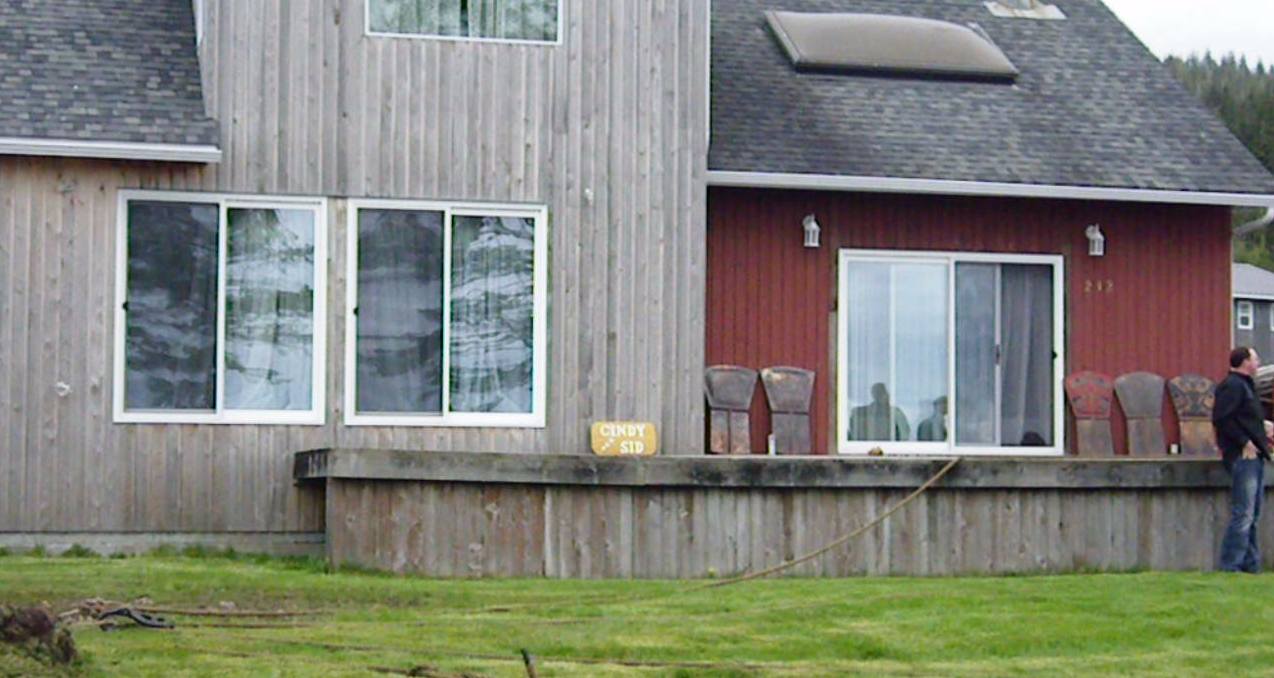
 The totem pole was moved to the sight where it was to be raised the day before the pole raising.  The pole was going up in front of Chief Wigaanad Sid Crosby's home.  On the porch are five "coppers" which in the Northwest Coast Native culture is a symbol of wealth.
 Chief Wiigaanad Sid Crosby(second from right), his wife Cindy(right), Cindy's brother Master Carver Tim Boyko(centre) and other family members.
 The "Boss Lady" and her auntie.  The Haida are a Matriarchal society so Cindy really is the "Boss Lady".  If you are Haida you are either an Eagle or a Raven and if you are one you must marry the other.  Chief Wiigaanad is Eagle and Cindy is a Raven.  Children follow the mother's moiety so the next chief of the Skidegate Gidins would be Cindy's brother's first born son.  Cindy is wearing a beautiful interpretation of a "button blanket".
 Another beautiful eagle blanket and cedar hat.  Cedar bark is stripped from the Western Red Cedar or Yellow Cedar, peeled into thin strips, soaked and woven into these beautiful rain proof hats.  The flare on the hat sends the rain off the shoulders.  Red cedar bark is strong with long fibres and was/is used for making baskets, rope, hats and when felted capes, leggings and aprons and was also woven with mountain goat wool for additional warmth and beauty.
 There is strong tradition in the raising of a pole.  Diane Brown is blessing the pole, next the carver and his apprentices will dance around the pole and breath life into it, family members will be invited to place trade beads in the hole(rumour has it that in the old days they would place a slave in the hole!) and the chief's permission is asked to raise the pole.
 Traditionally the pole would be raised with four to six ropes and upwards of 25 to 50 or more people on each line.  Because this pole was going up between two houses a block and tackle system was used with the additional help of people.  As the pole is slowly raised a timber crib is created to support the pole as it goes up.  On the right hand side of this photo just above the rope pulley(orange tape) you will see a piece of 2x4.  Just after I took this photo that rope broke and the piece of 2x4 and the whipping rope struck two children and an adult.  The kids where more fightened than hurt however the spectator/photographer/nurse was struck with the 2x4 breaking his arm, camera and several ribs.  He was stabilized on scene by no less than 3 doctors and 3 fellow nurses, taken to hospital in Queen Charlotte and then air medivac to Vancouver where he is recovering well. 
 An hour and a half later the pole was raised(the yellow rope is the new line) without further incident.
 The pole is forty feet tall with the Wasco(sea bear) holding a killer whale on the bottom, a raven representing  Cindy , a dog fish(where the blankets and ropes are) and an eagle on top. 
Once the pole is straight, the hole is filled in with rocks(the pole is buried 15' deep) and sand.
 Throughout the pole raising Chief Wiigaanad watched ...someone is hired to raise the pole. 
 Cindy and friends watched and waited from a respectfully distance.
 When it was finally raised there was a collective sigh of relief and cheer!
 If you look carefully you will see five eagles.  If I had not been there to witness this I would not have believed it.  As the pole was being raised the eagles sqawked and made a ruckous as if in support of Chief Wiigaanad.  When the rope broke everyone, including the eagles fell silent.  When the pole was finally raised not only did the eagle ruckous continue but eagles flew in to join the celebration...it was really quite amazing to witness.
 There was support from every where in the form of prayers
 and song.
I will continue this tomorrow with the potlatch.
To visit other fascinating places from around the world by not join us a

Sunday, May 22, 2011

Totem Pole on the Move

photo by Jessica Reid 
Chief Sid Crosby's totem pole is complete and ready to be raised but first it needs to be moved.
photo by Jessica Reid 
Now it is time to move it, the preparations begin. 
 photo by Jessica Reid
This pole will be moved by human power
photo by Jessica Reid 
to it's destination just over three kilometers(1.8 miles) away
photo by Jessica Reid
with all kinds of support....more to come!
Scenic Sunday

Tuesday, May 17, 2011

My World Tuesday ~ Potlatching

This weekend the Skidegate Gidins will host a pole raising and potlatch to honour their new chief.

Potlatch, from the Chinook word(a common trading language of the Northwest coast indigeneous peoples) means "to give away" or "a gift" and was a social gathering by a hereditary chief or family in their house(longhouse) to establish or uphold his/their status position in society and to redistribute wealth. In a culture where history is passed on in an oral tradition potlatches were mainly winter cermonies to mark a significant event such as a son's marriage, the passing of a chief, the birth of a child or the installation of a new chief.  Potlatches are distinguished from feasts in that guests are invited to a potlatch to share food and receive gifts or payment for witnessing the event. Potlatches were also the venue in which ownership to economic and ceremonial privileges was asserted, displayed, and formally transferred to heirs.
This beautiful pole, which was commissioned by Chief Syd Crosby from Master carver Tim Boyko will be raised outside of Sydney's home in Skidegate.  (In older times it would have been raised in front of the clan longhouse.)  Following the pole raising in which everyone is welcome to help raise the pole the potlatch will be held.  The story of the pole will be told and the carver will be honoured and paid along with his apprentices.
The top figure on Syd's pole is an eagle and the post with the two rings on it represents the two potlatches that Sydney has/will host.  There are old totem poles with many rings representing many potlatches.  The photo below from BC Archives shows a memorial pole to a chief who in his life time hosted 10 potlatches.
The potlatch was seen by the church and the government as "the ritualistic act of giving away nearly all of one’s hard-earned possessions as a sign that the indigenous people were ‘unstable’".  Yet the potlatch was the First Nations primary connection to their culture and the redistribution of wealth among their people.  Your wealth was determined by how much you gave away not by how much you had!   In 1880 an amendment was made to the Indian Act of Canada that banned the potlatch and proclaimed that:

 "Every Indian or other person who engages in or assists in celebrating the Indian festival known as the “Potlatch” or in the Indian dance known as the “Tamanawas” is guilty of a misdemeanor, and liable to imprisonment for a term of not more than six nor less than two months in any gaol or other place of confinement; and every Indian or persons who encourages… an Indian to get up such a festival… shall be liable to the same punishment."

This Amendment to the Indian Act was meant to assimilate the First Nations people into the European culture however without the support of many of the Indian Agents it was a hard law to uphold.  Some First Nations willing let the potlatch go however those like the Haida and the Kwakwakaʼwakw continued to practice the potlatch however in a much simpler form.  The Anti-Potlatch ban was repealed in Canada in 1951 and the potlatch has become an important part of the resurgance of the Northwest culture.  It is full of song, dance, regalia, food and pride and I will post lots of pictures next week!  
To visit other great places in Our World why not join us at

Sunday, May 08, 2011

"Blue Skies Do I See, Nothing but Blue Skies Do I See...."

 Like much of the North American continent it has been a cool spring.  Here we have been hard pressed to get into double digits on the thermometer and grey skies, rain and wind have been the norm.
 Today was "Move For Health Day" in British Columbia and it seems the weatherman was on our side with beautiful blue skies, big fluffy clouds and warm temperatures for our community hike! 
 On our way back up the coast we stopped for Chai and to see if we could spot the gray whales that come to visit every spring.
For other lovely reflections and beautiful scenes from around the world why not join us at

LinkWithin

Blog Widget by LinkWithin